

Insights

Expert articles, thought leadership, AI in cardiology.

Post-Operative Cardiac Injury Detection: The Hidden Failure Behind “Successful” Surgery

Post-operative cardiac injury detection showing patient leaving hospital after surgery with undetected cardiac risk

Post-operative cardiac injury detection is becoming a critical challenge as cardiovascular care advances. Success is no longer defined strictly by survival on the operating table. Today, the real challenge lies in the “blind spot” of the peri-operative window — what happens after the patient leaves the recovery room. Recent data published in the European Heart […]

Post-Operative Cardiac Injury Detection: The Hidden Failure Behind “Successful” Surgery Read More »

AI Cardiac Diagnostic Devices: How Cardio-HART Is Transforming Cardiology Diagnostics

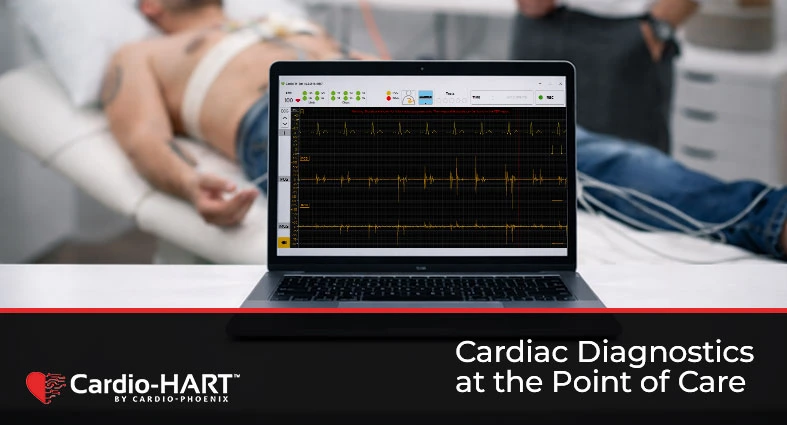
Cardio-HART cardiac diagnostic system displayed on a laptop in a primary care setting while a patient undergoes ECG-based cardiac assessment

Artificial intelligence is rapidly reshaping healthcare, particularly through the development of AI cardiac diagnostic devices that enable earlier detection of cardiovascular disease. These AI-driven tools help clinicians identify disease earlier, improve workflow efficiency, and deliver specialist-level insights directly at the point of care. One of the most promising developments is the emergence of AI cardiac

AI Cardiac Diagnostic Devices: How Cardio-HART Is Transforming Cardiology Diagnostics Read More »

ECG Is Failing Us — and Guidelines Already Know It

ECG is failing us as an elderly patient waits in a hospital corridor despite a normal ECG result

A clinical opinion inspired by a real case from ESC Congress, Madrid 2025 ECG is failing us when it is treated as sufficient for ruling out structural and functional heart disease. It is fast, inexpensive, widely available, and indispensable for rhythm assessment — particularly atrial fibrillation. But familiarity can quietly turn into overreliance. A real

ECG Is Failing Us — and Guidelines Already Know It Read More »

NT-proBNP Heart Failure Diagnosis in Primary Care: Where Current Pathways Fail and How Cardio-HART Complements Them

NT-proBNP heart failure diagnosis in primary care showing Cardio-HART report, heart anatomy, and blood sample

NT-proBNP heart failure diagnosis in primary care has long relied on biomarker-led pathways, yet remains limited—especially for patients with heart failure with preserved ejection fraction (HFpEF). However, its diagnostic value is more limited in heart failure with preserved ejection fraction (HFpEF), which represents a growing and often underdiagnosed clinical challenge. In real-world primary care, NT-proBNP

NT-proBNP Heart Failure Diagnosis in Primary Care: Where Current Pathways Fail and How Cardio-HART Complements Them Read More »

LVEF in Primary Care: Redefining Early Heart Failure Diagnosis

LVEF in Primary Care showing heart anatomy, Cardio-HART diagnostic report, and blood samples used in early heart failure assessment

LVEF in Primary Care is becoming essential as heart failure (HF) continues to rise globally, driven by population ageing and the increasing prevalence of hypertension, diabetes, and obesity. In the UK, around 900,000 people live with heart failure, and projections suggest this number will rise by 25% over the next two decades. Early detection matters:

LVEF in Primary Care: Redefining Early Heart Failure Diagnosis Read More »

Device-Based Heart Failure Diagnostics: Why Tools Beyond NT-proBNP Are Needed

Device-based heart failure diagnostics combining cardiac imaging, blood biomarkers, and Cardio-HART diagnostic report

Executive Summary Device-based heart failure diagnostics are increasingly recognized as essential to complement NT-proBNP testing. Although NT-proBNP remains central to current diagnostic pathways, clinical evidence and guideline recommendations highlight clear limitations—particularly in HFpEF and complex patient populations. This article outlines why tools delivering echocardiography-like outputs are needed to improve accuracy, reduce delays, and relieve pressure

Device-Based Heart Failure Diagnostics: Why Tools Beyond NT-proBNP Are Needed Read More »

Evaluating NT-proBNP Thresholds and Referral Pathways in Heart Failure Diagnosis: A Comparative Analysis of NHS and EU Practices

Illustration showing NT-proBNP thresholds in heart failure diagnosis compared between NHS and EU practices, with Cardio-HART report and blood samples.

NT-proBNP thresholds in heart failure diagnosis are essential for understanding how different healthcare systems identify and manage the disease. N-terminal pro B-type natriuretic peptide (NT-proBNP) is a key biomarker used in diagnosing heart failure (HF). However, the threshold levels that trigger referral and further testing vary significantly between healthcare systems, influencing both diagnostic accuracy and

Evaluating NT-proBNP Thresholds and Referral Pathways in Heart Failure Diagnosis: A Comparative Analysis of NHS and EU Practices Read More »

The Decision to Order NT-proBNP: How ECG Findings and Clinical Factors Influence Testing

Laptop showing a Cardio-HART report with blood test tubes and a heart illustration – NT-proBNP and HFpEF diagnostic gaps in primary care.

Heart failure with preserved ejection fraction (HFpEF) is increasingly recognized as a common subtype of heart failure, particularly in older adults and women over the age of 65. Despite representing more than half of heart failure cases in this demographic, HFpEF is still underdiagnosed in primary care. A major reason lies in the limitations of

The Decision to Order NT-proBNP: How ECG Findings and Clinical Factors Influence Testing Read More »

NT-proBNP Testing in Heart Failure with Preserved Ejection Fraction (HFpEF): Diagnostic Challenges and Clinical Implications

Laptop showing a Cardio-HART report with blood test tubes and a heart illustration, representing NT-proBNP testing and diagnostic gaps in HFpEF.

NT-proBNP in HFpEF diagnosis is increasingly recognized as a challenge, particularly among older women. Addressing these diagnostic challenges is critical because HFpEF now represents more than half of all heart failure cases in older adults, and timely recognition can substantially reduce hospital admissions. Despite its growing significance, HFpEF remains frequently underdiagnosed in primary care due

NT-proBNP Testing in Heart Failure with Preserved Ejection Fraction (HFpEF): Diagnostic Challenges and Clinical Implications Read More »

The Impact of Obesity on NT-proBNP in Heart Failure: Focus on HFpEF and Early Diagnosis

NT-proBNP in Heart Failure: obesity complicates diagnosis and HFpEF detection with Cardio-HART support

Key takeaways (TL;DR): NT-proBNP in Heart Failure is central to diagnosis, but obesity complicates interpretation. Obesity has emerged as a significant health challenge, particularly as the aging population in the UK continues to grow. With one in four adults in the UK classified as obese, this condition is becoming one of the leading contributors to

The Impact of Obesity on NT-proBNP in Heart Failure: Focus on HFpEF and Early Diagnosis Read More »