

Cardio-HART heart failure detection in primary care addresses one of the biggest limitations of standard ECG: the inability to reliably identify many structural and functional heart diseases during early patient presentation.
Why Primary Care Needs More Than a Standard ECG
Every day in Primary Care, clinicians see patients with symptoms that may suggest underlying cardiovascular disease:
- shortness of breath
- fatigue
- reduced exercise tolerance
- palpitations
- chest discomfort
- hypertension
- diabetes
- obesity
The challenge is that many of these patients do not present with obvious cardiac pathology during the early stages of disease.
And this is exactly where the limitations of the standard 12-lead ECG begin to create problems.
ECG remains one of the most important frontline cardiac tools in medicine. It is fast, accessible, familiar, and essential for detecting rhythm disorders, ischemic changes, and acute cardiac events.
But ECG was never designed to provide detailed information about structural and functional heart disease.
Conditions such as:
- Heart Failure with Preserved Ejection Fraction (HFpEF)
- early left ventricular dysfunction
- valve disease
- chamber enlargement
- diastolic dysfunction
are often difficult, borderline, or impossible to identify through ECG alone.
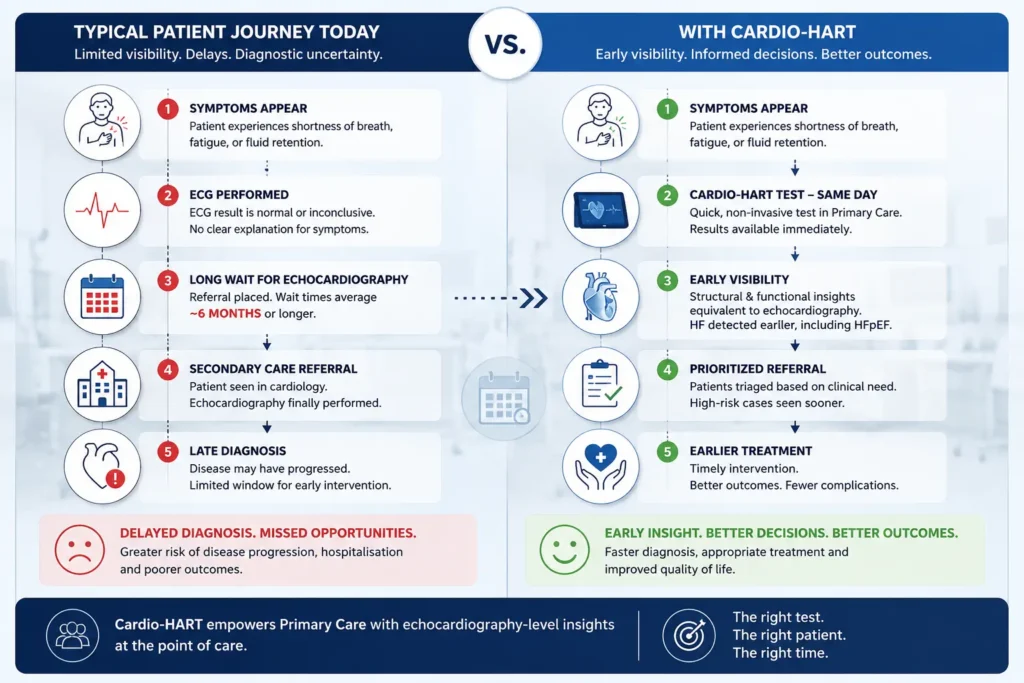
As a result, many Primary Care clinicians are left in a difficult position:
- symptoms are present
- ECG may appear inconclusive or borderline
- echocardiography is unavailable or delayed
- referral pathways are overloaded
- clinical uncertainty remains
In many healthcare systems, echocardiography waiting times can extend for months. During that period, disease progression continues.
This is one of the biggest unmet needs in modern cardiovascular diagnostics:
how to provide better cardiac decision support earlier, directly at the point of care.
The Problem With “Normal” or Inconclusive ECG Results
One of the biggest operational problems in Primary Care is not necessarily an abnormal ECG.
It is the inconclusive ECG.
Many patients with early-stage cardiovascular disease do not generate sufficiently strong electrical abnormalities to produce clear ECG findings. This is especially true in cases involving structural or functional dysfunction rather than purely electrical pathology.
In practice, this creates several risks:
- delayed diagnosis
- unnecessary referrals
- missed Heart Failure cases
- uncertainty in referral prioritization
- repeated visits before escalation
- avoidable emergency admissions later
Heart Failure with Preserved Ejection Fraction (HFpEF) is a particularly important example.
Patients may present with:
- fatigue
- mild dyspnea
- exercise intolerance
- hypertension
- obesity
- diabetes
yet standard ECG may provide little actionable evidence.
The result is often a prolonged diagnostic pathway where patients deteriorate before definitive diagnosis is finally reached in secondary care.
Primary Care clinicians understand this reality well.
The issue is not that ECG lacks value.
The issue is that ECG alone cannot provide the structural and functional insight required for many common cardiovascular diseases.
| Capability | ECG | Cardio-HART |
|---|---|---|
| Rhythm analysis | ✖ | ✔ |
| HF detection | Limited | ✔ |
| Valve disease | ✖ | ✔ |
| Structural findings | ✖ | ✔ |
| HFpEF support | ✖ | ✔ |
| Early disease indication | Limited | ✔ |
Cardio-HART: Extending the Diagnostic Role of ECG
Cardio-HART was developed specifically to address this diagnostic gap.
Importantly, Cardio-HART is not designed to replace clinical workflows.
It is designed to fit directly into them.
From the clinician perspective, the workflow remains familiar:
- perform a standard ECG-style examination
- receive immediate results
- review cardiac findings during the consultation
But behind that familiar workflow, Cardio-HART expands the diagnostic capability far beyond traditional ECG.
Cardio-HART combines:
- a standard 12-lead ECG
- phonocardiography (PCG)
- mechanocardiography (MCG)
- AI-driven signal analysis
into a single point-of-care assessment.
The system analyzes:
- electrical activity
- heart sounds
- mechanical cardiac function
simultaneously.
This allows Cardio-HART to identify patterns associated with structural and functional cardiac abnormalities that are typically evaluated only through echocardiography.
The goal is not to replace echocardiography when Echo is clinically indicated.
The goal is to provide significantly earlier diagnostic visibility before patients reach that stage.
Why This Matters in Primary Care
Primary Care is where cardiovascular disease first appears.
But it is also where diagnostic uncertainty is often highest.
A GP may suspect:
- Heart Failure
- valve disease
- ventricular dysfunction
- pulmonary hypertension
- early cardiomyopathy
yet lack immediate access to the diagnostic evidence needed to confidently guide the next clinical decision.
This often creates two undesirable outcomes:
1. “Just in Case” Referrals
Patients are referred because pathology cannot be confidently excluded.
This contributes to:
- cardiology backlog
- long echocardiography wait times
- unnecessary secondary care burden
2. Missed Early Disease
Patients are reassured despite early pathology already being present but not detectable through ECG alone.
Disease progression continues until:
- symptoms worsen
- hospitalization occurs
- diagnosis becomes more obvious and more costly
Earlier detection changes this trajectory.
That is where Cardio-HART aims to support Primary Care clinicians.
AI Designed for Clinical Decision Support
Artificial intelligence in healthcare often generates skepticism, particularly when it appears disconnected from clinical workflow realities.
Cardio-HART takes a different approach.
Its AI is not designed to replace clinician judgment.
It is designed to strengthen clinical decision support.
The system analyzes multi-modal cardiac bio-signals to help identify:
- structural abnormalities
- functional dysfunction
- valve pathology
- Heart Failure indicators
- severity patterns
- referral urgency
while presenting findings in a clinically understandable format.
For Primary Care clinicians, this means:
- less ambiguity
- more diagnostic confidence
- clearer referral prioritization
- earlier intervention opportunities
without changing how the consultation itself operates.
Clinical validation studies have demonstrated improved sensitivity and specificity compared to standard ECG in Primary Care settings.
Maintaining Workflow Simplicity
One of the biggest barriers to adopting new diagnostic technologies in Primary Care is workflow disruption.
If a device:
- requires specialist operation
- adds major training complexity
- changes patient flow
- increases consultation burden
adoption becomes difficult regardless of capability.
Cardio-HART was developed with this operational reality in mind.
The examination remains:
- non-invasive
- ECG-like
- rapid
- suitable for routine Primary Care use
Importantly, it does not require:
- specialist sonographers
- cardiologist interpretation
- advanced imaging expertise
This allows clinics to expand diagnostic capability without fundamentally redesigning how frontline cardiac assessment is performed.
Earlier Insight Can Change Patient Pathways
The greatest value of improved cardiac diagnostics is not simply better reporting.
It is earlier clinical action.
When clinicians gain earlier visibility into:
- Heart Failure risk
- valve abnormalities
- structural dysfunction
- worsening cardiac status
they can:
- prioritize referrals more appropriately
- initiate treatment earlier
- reduce uncertainty
- monitor patients more effectively
- potentially slow disease progression before hospitalization occurs
For many patients, timing matters as much as diagnosis itself.
The Future of Primary Care Cardiac Assessment
Primary Care continues to absorb increasing cardiovascular burden:
- aging populations
- hypertension
- obesity
- diabetes
- chronic respiratory disease
- long-term cardiac monitoring needs
At the same time:
- cardiology services remain overloaded
- echocardiography access remains limited
- clinicians are expected to make earlier decisions with limited information
The traditional ECG remains essential.
But modern cardiovascular care increasingly requires more than electrical interpretation alone.
Cardio-HART represents an effort to extend the role of frontline cardiac diagnostics by combining ECG familiarity with AI-driven multi-modal analysis capable of identifying structural and functional disease patterns earlier in the patient pathway.
For Primary Care clinicians, this is not about replacing established practice.
It is about reducing diagnostic uncertainty where it matters most:
during the patient’s first presentation.
Compare ECG vs Cardio-HART in Primary Care
Standard ECG remains a critical frontline cardiac tool, but its limitations in detecting structural and functional heart disease can leave significant diagnostic gaps in Primary Care.
Download the ECG vs Cardio-HART comparison brochure to see how Cardio-HART expands beyond traditional ECG capabilities for:
- Heart Failure detection
- HFpEF assessment
- valve disease identification
- structural and functional cardiac findings
- referral decision support
- early disease detection
Download the ECG vs Cardio-HART Clinical Comparison Brochure
Interested in exploring how Cardio-HART could support earlier cardiac assessment and referral decisions in Primary Care? Schedule a short clinical introduction call.