



Regulatory Classification
(Class IIa) Under MDR
Why Cardio-HART is appropriately classified as a Class IIa medical device — and why that strengthens its clinical role.
Cardio-HART is designed as a clinical decision support system that extends the standard 12-lead ECG with functional insight while maintaining clear clinical boundaries. Under the EU Medical Device Regulation (MDR), its classification is determined by decision authority — not by the perceived importance of its output.
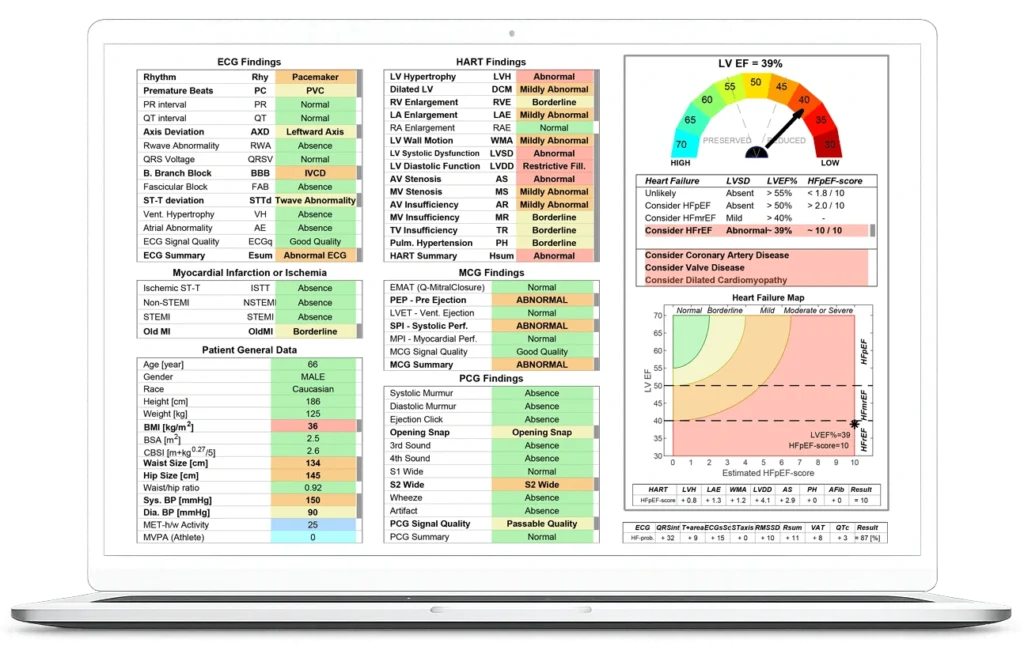
Why Cardio-HART May Feel Like a Class IIb Device
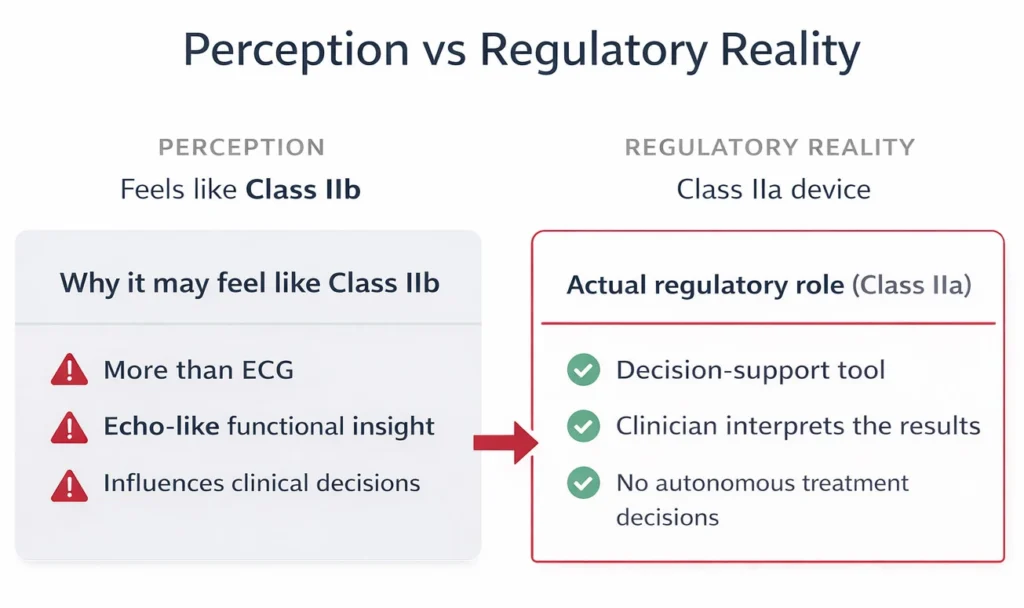
Many clinicians intuitively feel that Cardio-HART is “more than ECG” — and that instinct is understandable.
Cardio-HART:
- Replaces the traditional 12-lead ECG device in selected workflows
- Adds functional insight traditionally associated with echocardiography
- Influences important decisions in heart failure, oncology, and pre-operative care
This naturally raises the question:
If this information matters clinically,
shouldn’t it be Class IIb?
The answer lies not in how important the information is — but in how it is used.
What Cardio-HART Does
in Clinical Workflows
Cardio-HART is designed to answer a specific clinical question that clinicians frequently face:
Is an ECG abnormality functionally meaningful — and does this patient require escalation?
To support this role, Cardio-HART:
- Helps prioritize — not replace — echo
- Performs a full diagnostic-grade 12-lead ECG
- Adds electromechanical and acoustic context
- Provides supportive, echo-equivalent functional information for clinical evaluation
What Cardio-HART
Does Not Do
Cardio-HART does not:
- Make autonomous treatment decisions
- Replace echocardiography or clinician judgment
- Trigger irreversible interventions
This distinction is critical for understanding its regulatory classification.

Why Class IIa Is the Correct and Clinically Safe Classification
Under MDR, classification is determined by decision authority — not by perceived importance.
Cardio-HART:
- Provides supportive information
- Informs triage, prioritization, and surveillance
- Is always interpreted in clinical context
This places it in Class IIa, alongside tools clinicians already trust and use daily, including:
- Standard ECG
- Biomarkers (e.g., BNP)
- Imaging-support software
- Risk scores and clinical decision aids
Importantly:
No responsible clinical pathway relies on a single test — regardless of class — to make high-stakes decisions.
Why Cardio-HART Is Correctly Classified as Class IIa
If Cardio-HART Were Class IIb
In an outpatient clinic, if Cardio-HART were classified as a Class IIb device, its output could be interpreted as directly guiding treatment decisions without clinical oversight.
This is not the intended role of Cardio-HART.
How Cardio-HART Is Actually Used (Class IIa)
- The healthcare professional remains responsible for interpretation
- Cardio-HART supports referral and diagnostic prioritization
- treatment decisions remain clinician-led
Cardio-HART functions as a clinician-in-the-loop decision support tool, consistent with MDR Rule 11.
Clinical Context: Where Class IIa Fits in Practice
Cardio-HART integrates into diverse care settings as a supportive clinical decision tool under MDR Class IIa.
Heart Failure Clinics:
What Class IIa Enables
In heart failure clinics, Cardio-HART is used to:
- Identify impaired relaxation and stiffness (HFpEF)
- Differentiate heart failure phenotypes earlier
- Decide who needs echocardiography now versus who can safely wait
These are longitudinal, confirmatory workflows.
Class IIb would not:
- Change how heart failure decisions are made
- Replace echocardiography
- Increase diagnostic certainty beyond the supportive role
Class IIa is sufficient — and appropriate — for
this setting.
Outpatient Cardiology:
Why IIb Adds No Clinical Value
In outpatient settings, clinicians need:
- Speed
- Clarity
- Better triage than ECG alone
Cardio-HART:
- Replaces the ECG device within routine workflows
- Adds functional meaning to ambiguous ECG findings
- Reduces defensive or unnecessary echo referrals
Raising classification to IIb would:
- Add governance and friction
- Slow deployment
- Increase perceived medico-legal burden
Without improving actual decision quality.
Cardio-Oncology & Pre-Surgical Assessment
In cardio-oncology and pre-operative care, Cardio-HART functions as:
- A between-treatment surveillance tool
- An early warning system
- A way to detect functional deterioration earlier
Crucially:
- No chemotherapy is stopped
- No surgery is cancelled
- No treatment is initiated
without confirmatory imaging or specialist review.
Cardio-HART strengthens these pathways — it does not replace them.
Class IIa is not a limitation here; it is a safeguard.
Why Cardio-HART Is Powerful
Because It Is Class IIa
Class IIa allows Cardio-HART to:
- Be used broadly and early
- Support clinicians without over-claiming authority
- Integrate naturally into existing pathways
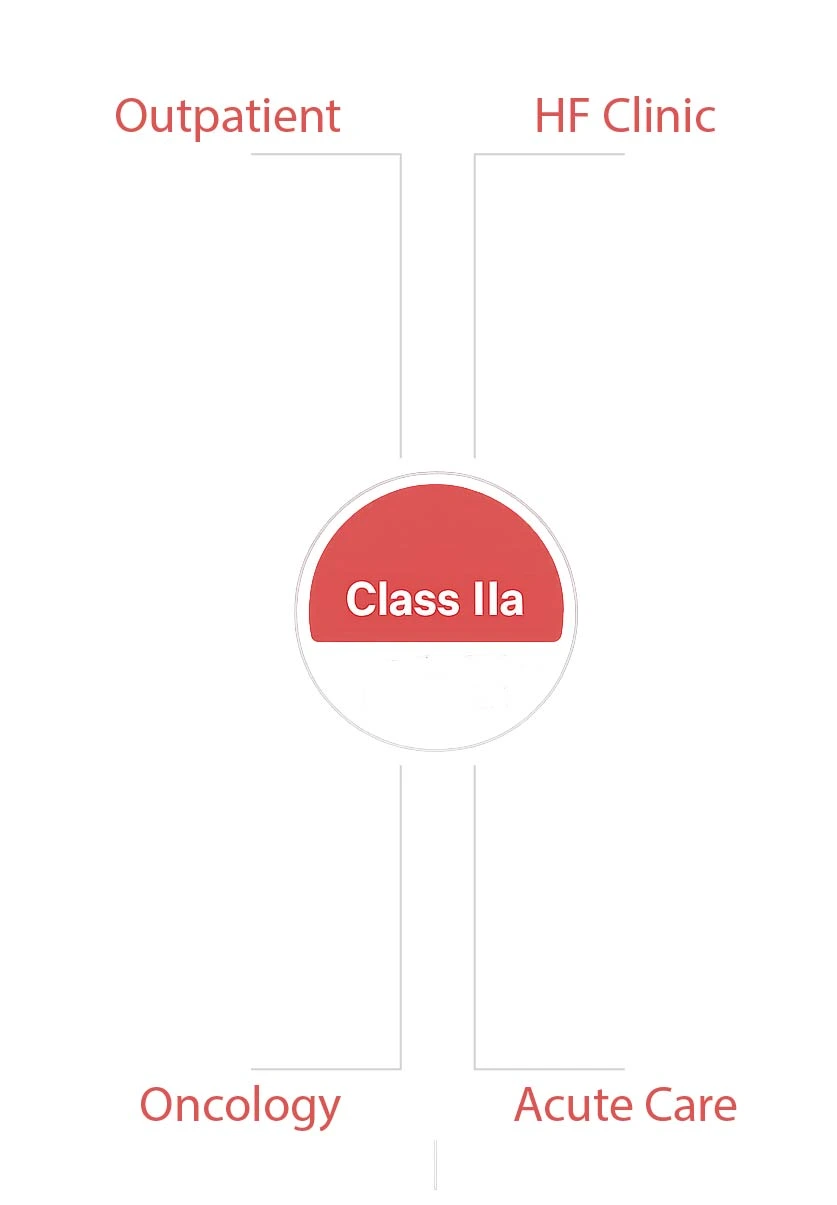
- Scale safely across outpatient, heart failure, oncology, and acute settings
Higher classification does not mean better medicine — it means narrower use.
Cardio-HART is designed to be useful where decisions are made, not only where risk is highest.
Clinical Takeaway
Cardio-HART replaces the traditional ECG device within certain diagnostic workflows
It extends ECG with functional, echo-equivalent insight
It improves triage, prioritization, and early detection
It does so without overstepping clinical or regulatory boundaries
Cardio-HART is intentionally positioned as a Class IIa device — because that is where it delivers the greatest clinical value, safely and responsibly.
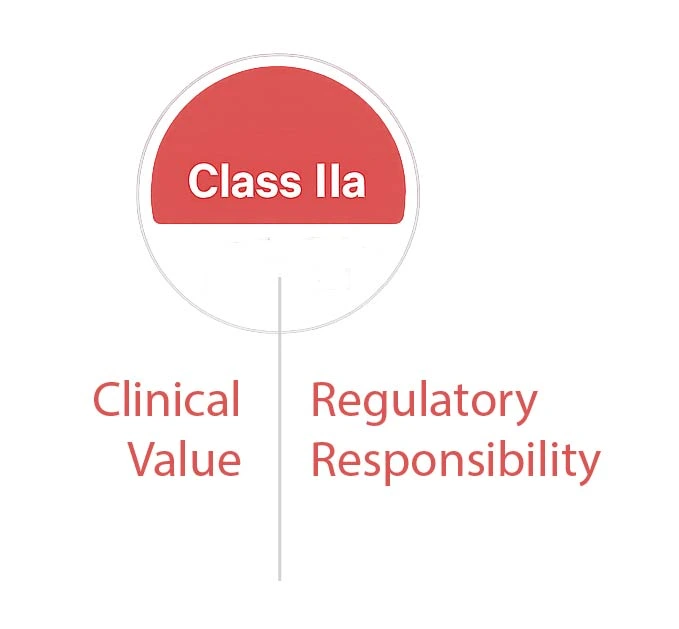
Cardio-HART provides the functional context ECG lacks at the point where echocardiography is often unavailable — as a supportive, clinically integrated tool rather than an autonomous decision-maker.
Have a Question About Cardio-HART?
Submit your inquiry below, and our team will respond with the information you need.