



When the trace does not resolve the question
When the ECG is reassuring, but the patient is not.
Every primary care physician knows this patient. Symptoms persist. The ECG appears normal. Yet the clinical picture still does not feel reassuring.
The challenge is not reading the trace. It is deciding whether the patient can remain in primary care, or whether further cardiac investigation is needed.
Already familiar with Cardio-HART? Book a demo instead →
“I replaced my standard ECG with Cardio-HART. I’ve come to trust it to the point that I cannot ignore it. What it detects, the echo confirms.”
Dr Teresa Castiello — Cardiology President, Royal Society of Medicine (2023–2025)
1 In 70% of cases agreement is >90%; in an additional 25% agreement ranges between 75–90%.
2 Source: Cardio-Phoenix Multicentre Study (2022); validation results presented at ESC-HFA 2023; peer-reviewed in European Heart Journal: Digital Health (2023).
The clinical gap
More uncertainty often begins after the ECG.
A reassuring ECG may not explain persistent symptoms, cardiovascular risk factors or the clinician’s concern. The next step still has to be decided, often before echocardiography is available.
Where Cardio-HART adds value
Know more before you refer.
Cardio-HART starts with the familiar 12-lead ECG and adds further cardiac biosignals to provide information about structure and function, with an immediate clinical report.
It is designed to support the next clinical decision, not replace clinical judgement or echocardiography when confirmatory imaging is required.
A real clinical case
The ECG appeared reassuring. Cardio-HART changed the clinical picture.
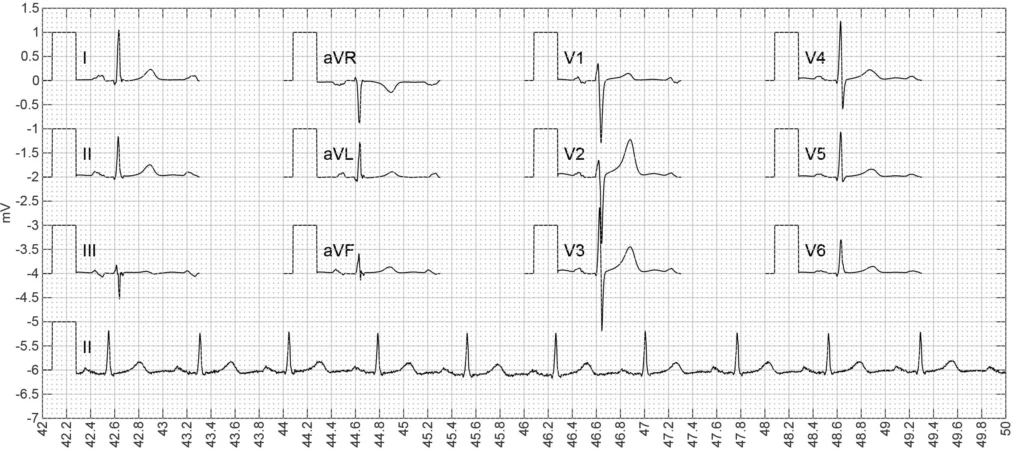
Below is a preview of the same patient assessed in two different ways. Only the first page of the Cardio-HART report is shown.
ECG findings appeared reassuring
The trace did not explain the patient’s clinical presentation.
The first page raised concern
Additional cardiac findings indicated that further investigation was required.
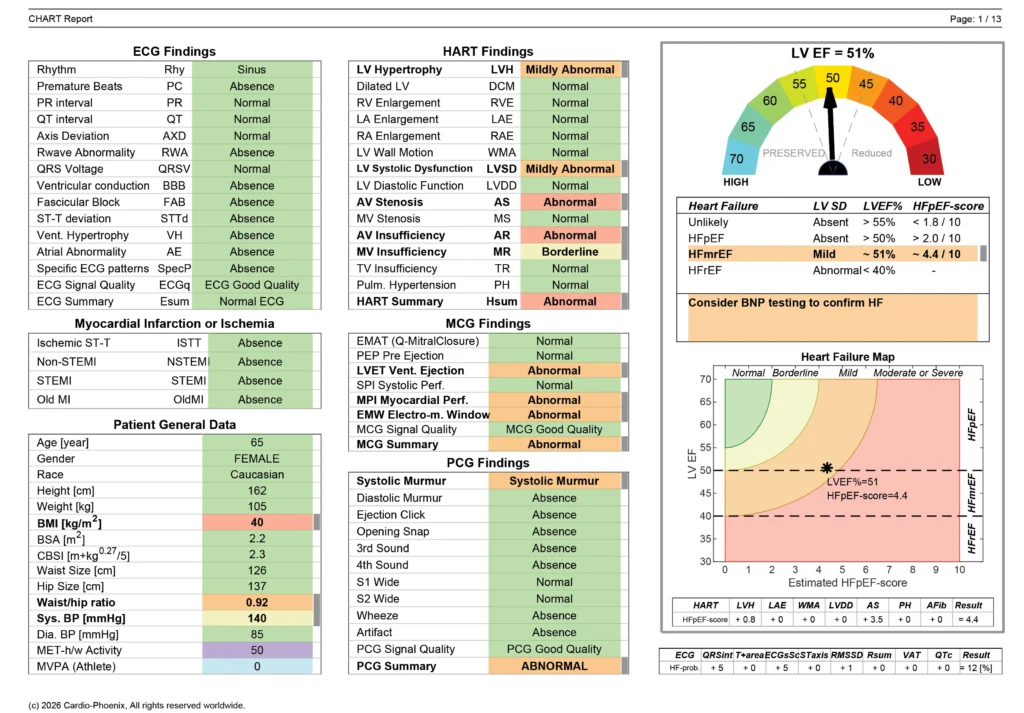
One test. One visit. A structural and functional picture standard ECG cannot provide on its own.
Complete clinical case
Normal ECG. Abnormal Cardio-HART Findings.
A guided clinical report review
A concise, case-based resource for primary care physicians, internists and general cardiologists.
Designed to be reviewed quickly and used as a practical clinical reference.
Download the full report
See what the ECG did not show.
Enter your work email to receive the complete Cardio-HART report and guided interpretation of the case.