

A clinical opinion inspired by a real case from ESC Congress, Madrid 2025
ECG is failing us when it is treated as sufficient for ruling out structural and functional heart disease. It is fast, inexpensive, widely available, and indispensable for rhythm assessment — particularly atrial fibrillation.
But familiarity can quietly turn into overreliance.
A real case encountered at the European Society of Cardiology Congress in Madrid in 2025 illustrates a persistent problem in everyday practice: ECG findings are too often treated as reassuring when they were never designed to exclude structural or functional heart disease.
The full case is described here:
👉 A True Story: When Heart Failure Missed by ECG Confronts the Rent
The story that should give us pause
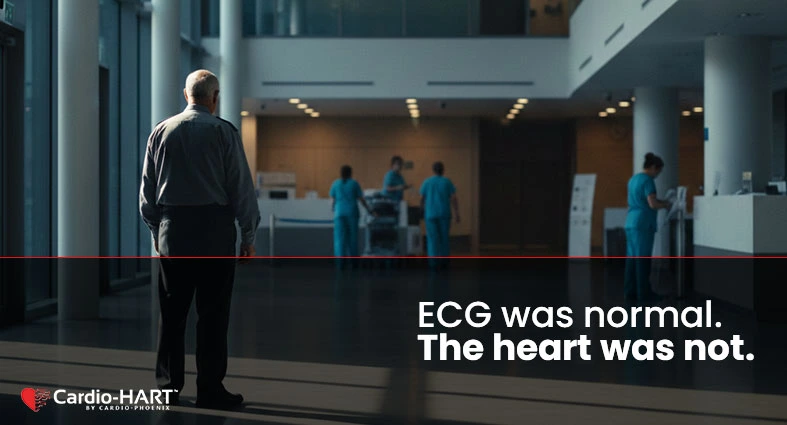
An older security guard working at the congress had a known history of atrial fibrillation. His GP had acted appropriately: medication was prescribed and an echocardiogram was requested — classified as routine. The appointment was scheduled eight months later.
During a technology demonstration, a CHART test was performed.
The ECG component confirmed atrial fibrillation, nothing more.
The echo-equivalent findings, however, indicated severe structural and functional abnormalities, reduced ejection fraction, and features consistent with advanced heart failure.
Two cardiologists independently reviewed the report and reached the same conclusion: this patient required urgent echocardiography, not a routine referral.
Yet when the patient presented to the emergency department, the report was dismissed. ECG was repeated. Medication was adjusted. He was discharged without imaging or escalation.
The disease had not been missed.
It had been set aside.
What ECG is — and what it is not
ECG is failing us when it is expected to exclude heart failure, even though it remains a cornerstone of cardiovascular assessment for rhythm disturbances, conduction abnormalities, and certain ischemic patterns.
What it cannot reliably do is assess:
- cardiac structure
- ventricular function
- early or moderate heart failure
- severity of valvular disease
This limitation is well understood in theory.
In practice, however, ECG is frequently used as a gatekeeper — implicitly determining whether further investigation is urgent or can wait.
When symptoms persist but ECG appears “acceptable,” escalation is delayed.
Guidance and reality are not the same thing
Clinical guidance does not position ECG as a standalone diagnostic tool for heart failure or structural disease. Confirmation requires assessment of cardiac structure and function, typically through echocardiography.
The problem, therefore, is not a lack of guidance.
It is the gap between what guidance expects and what systems routinely deliver.
Why innovation struggles to be heard
The Madrid case reflects a familiar pattern:
- a validated diagnostic tool identifies concerning findings
- experts confirm the clinical relevance
- the system rejects the information because it does not fit established pathways
“This is not standard procedure.”
“This means nothing to us.”
These are not scientific objections.
They are procedural ones.
Importantly, the cardiologists involved were explicit: the technology did not replace echocardiography — it enabled earlier and more intelligent triage.
The ethical dimension we rarely name
There is a further layer to this case that deserves attention.
The patient delayed care because missing work meant losing income. Private imaging was unaffordable. Waiting was not a preference — it was a necessity.
When diagnostic pathways rely on long delays and limited access to imaging, those with fewer resources are disproportionately affected. ECG-only decision making amplifies this inequality by offering false reassurance where further evaluation is needed.
This is not only a clinical issue.
It is a matter of equity.
What change realistically looks like
Progress does not require abandoning ECG.
It requires abandoning the assumption that ECG alone is sufficient.
That means:
- recognising validated point-of-care diagnostics that provide structural and functional insight
- allowing such findings to appropriately escalate referral urgency
- educating teams to interpret and act on data that goes beyond rhythm
- aligning everyday pathways with the intent of existing guidance
The objective is not more testing, but better triage — earlier.
The risk of reassurance
The most dangerous diagnostic outcome is not an abnormal result.
It is a reassuring one that delays action.
The Madrid case did not expose a failure of cardiology.
It exposed the consequences of systems that hesitate to act on what cardiology already understands.
ECG is failing us when it continues to be treated as sufficient, causing us to miss what it was never meant to reveal.